
Implant Surfaces and Osseointegration: Understanding the Biological Interface
How surface topography, chemistry and wettability influence bone healing — and what current clinical evidence tells us about their significance.
The success of a dental implant depends on a biological relationship that develops long after the surgical procedure has been completed. Although implant design, bone quality and surgical technique are fundamental to initial stability, lasting fixation requires the establishment and maintenance of direct functional contact between living bone and the implant surface.
This process, known as osseointegration, has been central to the development of modern implant dentistry. Over the past several decades, advances in surface engineering have transformed titanium implants from relatively smooth, machined devices into sophisticated structures with carefully controlled topographical and chemical characteristics.
Yet an important question remains: to what extent do these modifications influence outcomes that genuinely matter in clinical practice?
Understanding the distinction between biological potential, experimental findings and demonstrated clinical benefits is essential when evaluating contemporary implant technologies.
Osseointegration begins at the surface
–
When an implant is inserted into a prepared osteotomy, its surface comes into immediate contact with blood and extracellular proteins. This initiates a sequence of biological events involving clot formation, inflammatory signalling, cellular recruitment and the deposition of new bone.
Osteogenic cells subsequently participate in the formation and remodelling of bone at the implant interface. Over time, the initial mechanical fixation provided by the implant’s engagement with surrounding bone is complemented by biological stability as osseointegration progresses.
The implant surface is therefore not simply a passive boundary between titanium and living tissue. Its physical and chemical characteristics can influence the environment in which these early biological processes occur.
Surface roughness, microstructure, chemical composition and wettability have consequently become important areas of implant research. Their effects, however, are interconnected and cannot always be separated from other aspects of implant design or the surgical protocol.
Why surface roughness matters
–
Early generations of titanium dental implants commonly featured machined surfaces with relatively limited microscopic irregularities. Subsequent research demonstrated that modified surfaces could promote favourable bone responses, leading to the widespread adoption of roughened implant surfaces.
Techniques such as sandblasting, acid etching, anodisation and combinations of these processes are used to modify surface topography at different scales.
Microscopic irregularities increase the available surface area and can influence cell attachment, differentiation and the development of bone-to-implant contact. Moderately rough surfaces have consequently become established in modern implant dentistry.
Nevertheless, roughness should not be treated as a simple measurement in which a higher value necessarily produces a better result.
The distribution, shape and scale of surface irregularities are relevant, as are surface chemistry and the surrounding biological conditions. Excessive roughness may also create challenges if an implant surface becomes exposed to the oral environment, where microbial biofilm accumulation and effective decontamination become important clinical considerations.
Recent clinical evidence has not established a consistent long-term advantage for one surface roughness category over another across all indications.
The objective of surface engineering is therefore not to maximise roughness, but to achieve characteristics that support favourable biological responses without introducing unnecessary complications.
Surface chemistry and the role of bioactive coatings
–
While surface topography influences the physical interaction between an implant and surrounding tissue, chemical modifications are intended to influence the biological environment at the interface.
One approach involves incorporating calcium phosphate compounds, including hydroxyapatite-related materials, into the implant surface.
Calcium phosphate is of particular interest because calcium and phosphate are fundamental constituents of mineralised bone. Depending on their composition and structure, calcium phosphate coatings may provide osteoconductive properties and influence the early interaction between the implant and bone-forming cells.
However, different coating technologies vary substantially in thickness, crystallinity, dissolution characteristics, adhesion and manufacturing method. It would therefore be misleading to assume that all calcium phosphate-coated implants behave in the same way.
Their performance must be assessed individually, taking into account both material characteristics and clinical outcomes.
A systematic review and meta-analysis published in Clinical Oral Investigations in October 2024 reported favourable findings for certain bioactive surface modifications, including improvements in bone-to-implant contact in the studies analysed.
The authors nevertheless evaluated a heterogeneous range of materials and experimental approaches, many involving short observation periods. Such findings contribute to the scientific rationale for bioactive surfaces, but they cannot automatically be translated into superior long-term survival for every commercially available coating.
This distinction is particularly important when manufacturers describe biological surface properties as clinical advantages.
Hydrophilicity: does better wettability mean faster healing?
–
Hydrophilicity describes the tendency of a surface to interact with and become wetted by water-based fluids. In implant dentistry, it has attracted attention because the earliest stages of healing begin with contact between the implant surface and blood.
A surface with favourable wettability may encourage more extensive fluid contact and influence the adsorption of proteins involved in subsequent cellular interactions.
These characteristics have prompted the development of hydrophilic and chemically activated implant surfaces intended to support the early stages of osseointegration.
Experimental evidence suggests that certain hydrophilic surfaces may improve early biological responses. However, the relationship between surface wettability and meaningful clinical improvements is less straightforward.
A 2025 systematic review and meta-analysis examining bioactive and traditional implant surfaces included 15 controlled studies involving 1,256 implants in 596 patients. It found no statistically significant difference in implant survival or marginal bone loss between the compared surface groups.
Although bioactive surfaces showed a greater increase in implant stability quotient measurements after three months, the review concluded that the available evidence was insufficient to justify a general claim that such surfaces safely enable immediate or early loading.
For clinicians, this is a particularly relevant distinction. Improved early biological interaction may be desirable, but it does not remove the need for appropriate assessment of primary stability, loading conditions and individual patient risk.
What does the evidence tell us about long-term outcomes?
–
The ability of an implant surface to support early bone healing is important, but implant success cannot be evaluated solely by early osseointegration.
Long-term outcomes depend on a considerably wider range of factors, including biological complications, prosthetic design, occlusal loading, patient-related risks and maintenance.
A systematic review published in the British Dental Journal in October 2025 analysed 30 studies involving 1,719 participants, examining the success and survival of titanium implants with different surface treatments.
Although the reviewed surface modifications generally demonstrated favourable clinical results, the researchers identified substantial differences in study designs, observation periods and reported outcomes. They concluded that further high-quality research was needed to establish which modifications offer superior long-term reliability.
A subsequent systematic review published in Bioengineering in March 2026 examined the relationship between implant surface characteristics and peri-implant outcomes. Across 13 included studies, most clinical comparisons showed relatively small differences in marginal bone loss and peri-implant parameters between contemporary surface types.
The review suggested that any surface-related advantages may be most relevant during early healing or under particular clinical conditions, whereas long-term peri-implant health remains strongly influenced by patient-specific and treatment-related factors.
This is consistent with the 2025 Academy of Osseointegration and American Academy of Periodontology consensus, which emphasised the importance of periodontal history, smoking, metabolic health, implant positioning, prosthetic factors, biofilm control and ongoing supportive care.
In other words, implant surface technology is an important component of modern treatment, but it is not an independent guarantee of long-term success.
SGS SBTC®: applying surface science to implant technology
–
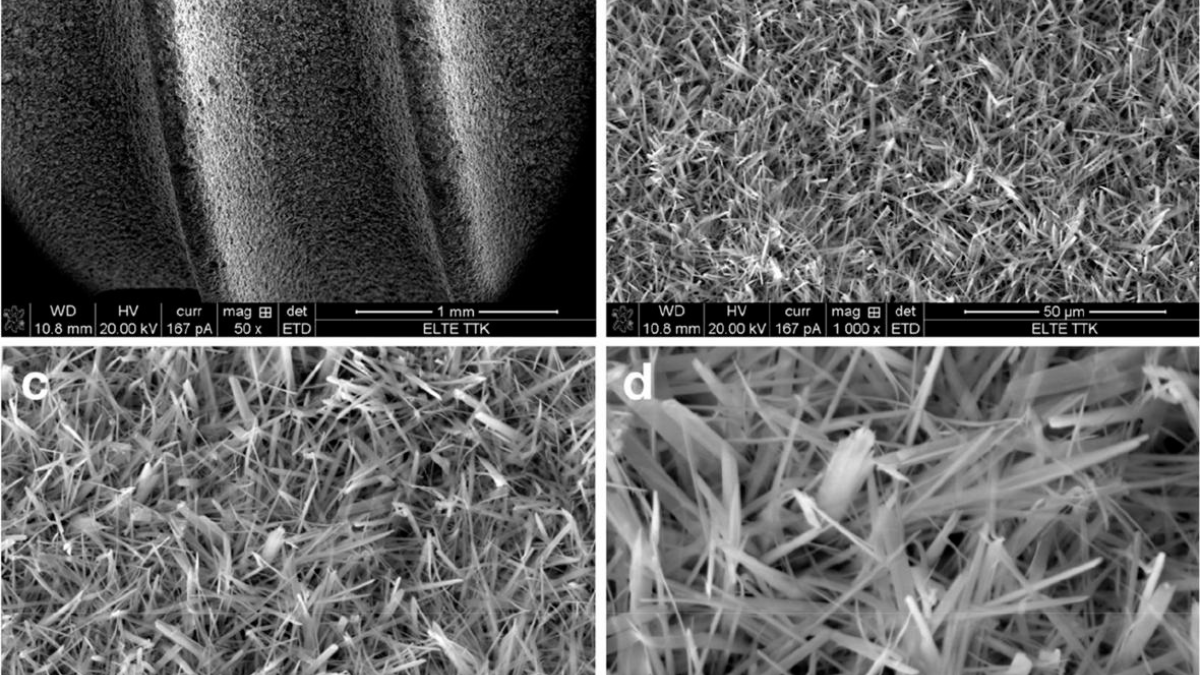
SGS Dental’s Smart Bioactive Trabecular Coating (SBTC®) is an electrochemically deposited calcium phosphate surface treatment developed to create a microstructured, bioactive interface.
Its design reflects the broader scientific interest in combining surface topography with chemical characteristics that may support bone-related biological activity.
The coating has also been investigated in a randomised controlled clinical trial published in Head & Face Medicine in April 2024.
The study involved 20 fully edentulous patients receiving a total of 40 SGS P7D implants. Each patient received one implant with the SBTC® coating and another with an established electrochemically deposited calcium phosphate control coating.
During the two-year observation period, all implants remained clinically stable, and no implant losses were recorded. Differences in implant stability and peri-implant bone-level changes between the surface groups were not statistically significant.
The findings support the clinical viability of SBTC® under the conditions investigated, although they do not demonstrate superiority over the control surface or establish equivalent outcomes across all implant designs and clinical indications.
For clinicians considering SGS implant systems, this research provides a useful example of how a specific surface technology can be evaluated through published clinical evidence rather than theoretical material properties alone.
Read more: SGS SBTC® Implant Surface: What Does the Clinical Evidence Show?
Surface technology within the complete treatment plan
–
The development of increasingly sophisticated implant surfaces has contributed to a better understanding of the interaction between biomaterials and living bone. Nevertheless, there are limitations to what even a well-designed surface can achieve.
Insufficient bone volume, inadequate implant positioning, excessive micromotion, unfavourable prosthetic loading or uncontrolled patient-related risk factors cannot be compensated for by surface characteristics alone.
Similarly, the decision to pursue immediate, early or conventional loading should not rest on assumptions about a surface treatment’s biological potential.
Primary stability, implant macrogeometry, the surgical site, prosthetic conditions and the patient’s overall clinical circumstances must be evaluated together.
This broader perspective is particularly relevant when comparing implant systems intended for different anatomical and restorative situations. An implant designed for dense bone and one developed for narrow interdental spaces may incorporate related surface technology while differing substantially in their mechanical behaviour and clinical indications.
Understanding those differences is part of responsible implant selection.
Beyond the surface
–
Modern implant surfaces represent decades of research into the relationship between biomaterials and biological tissues. Their evolution has expanded the possibilities available to clinicians, particularly in understanding the early stages of osseointegration.
At the same time, contemporary research increasingly supports a balanced interpretation of surface-related benefits. No single characteristic determines whether an implant will perform successfully over the long term, and results obtained with one surface, implant design or patient population should not automatically be generalised to others.
For dental professionals, the most useful approach remains an evidence-informed assessment of implant technology within the complete surgical, restorative and maintenance framework.
A well-designed implant surface can contribute to that process. Clinical predictability, however, depends on considerably more than the surface alone.
References and further reading
1. Abdo VL, et al. (2025). Success and survival of titanium surface modification on dental implant osseointegration: a systematic review. British Dental Journal, 239, 571–577.
2. Canullo L, et al. (2025). Do Super-hydrophilic Surfaces Affect Implant Primary Stability in the Early Healing Phase of Osseointegration? A Systematic Review with Metanalysis. Oral Health & Preventive Dentistry, 23, 469–478.
3. Al Shayeb M, et al. (2024). Bioactive surface modifications on dental implants: a systematic review and meta-analysis of osseointegration and longevity. Clinical Oral Investigations, 28, Article 592.
4. Antal MA, et al. (2024). Assessment of a novel electrochemically deposited smart bioactive trabecular coating (SBTC®): a randomized controlled clinical trial. Head & Face Medicine, 20, Article 24.
5. Implant Surface Characteristics and Peri-Implant Outcomes: A Systematic Review of Clinical and Microbiological Evidence. (2026). Bioengineering, 13(3), 299.
6. Wang HL, et al. (2025). AO/AAP consensus on prevention and management of peri-implant diseases and conditions: Summary report. Journal of Periodontology, 96(6), 519–541.
For dental professionals only.
This article summarises selected scientific publications and is not a substitute for individual clinical judgement, appropriate professional training or the manufacturer’s current instructions for use.