
Primary Stability and Implant Loading: Clinical Considerations Beyond Insertion Torque
Understanding the relationship between mechanical stability, bone quality, implant design and loading protocols in modern implant dentistry.
Primary stability has long been regarded as one of the fundamental requirements for predictable dental implant treatment. It describes the mechanical fixation achieved when an implant is placed into the prepared bone, providing the initial resistance to movement before biological osseointegration develops.
Its importance becomes particularly apparent when immediate or early loading is considered. Yet while insertion torque and implant stability quotient (ISQ) measurements are routinely used to assess stability, neither provides a complete picture of the biological and mechanical conditions required for successful treatment.
Recent clinical research has challenged the assumption that higher initial stability measurements necessarily lead to better long-term outcomes. The relationship is more complex, involving bone characteristics, implant macrogeometry, surgical preparation, prosthetic design and the timing and magnitude of functional loading.
For clinicians, the relevant question is not simply how much stability an implant achieves at placement, but whether that stability is appropriate for the intended treatment protocol.
Primary and secondary stability: two different processes
–
Implant stability changes throughout the healing period, reflecting the transition from mechanical fixation to biological integration.
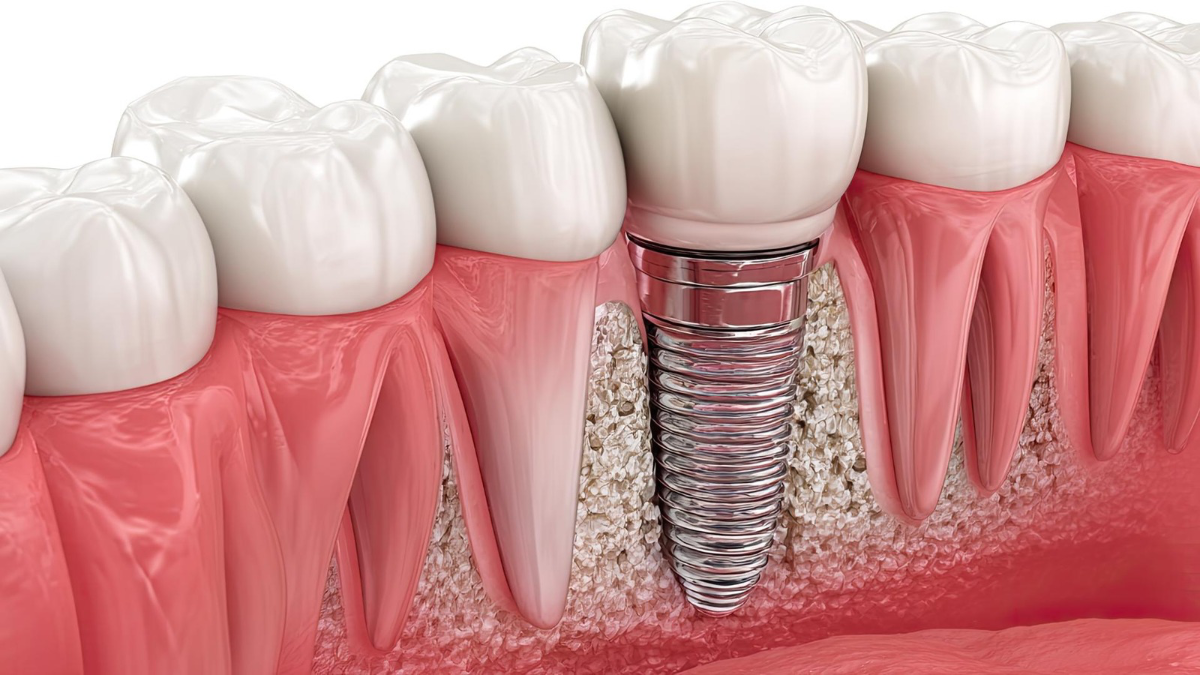
Primary stability is established during insertion through the mechanical engagement of the implant with surrounding bone. Its magnitude depends on factors including cortical bone thickness, trabecular density, implant dimensions, thread geometry and the relationship between the implant and the prepared osteotomy.
Secondary stability develops progressively through bone healing and remodelling at the implant interface. As newly formed bone matures, biological fixation increasingly contributes to the overall stability of the implant.
These processes do not necessarily progress at the same rate.
During early healing, remodelling of the initially engaged bone may temporarily reduce the mechanical contribution to stability, while newly deposited bone has not yet reached full maturity. This transition is sometimes described as a stability dip, although its timing and magnitude vary considerably between clinical situations and implant systems.
An implant that achieves substantial mechanical fixation at placement may therefore exhibit changing stability measurements during healing without this necessarily indicating treatment failure.
Conversely, an implant with relatively modest initial stability may develop satisfactory secondary stability when an appropriate healing period is allowed.
Understanding this distinction is particularly important when evaluating immediate loading protocols, in which the restoration must be managed while the biological interface is still developing.
Insertion torque: useful, but not a universal predictor
–
Insertion torque measures the rotational resistance encountered during implant placement and is usually expressed in Newton centimetres (Ncm).
It provides immediate information about the mechanical interaction between the implant and its surrounding bone. Higher values often reflect stronger mechanical engagement, although they can also be influenced by implant macrogeometry, surgical preparation and local compression.
In clinical practice, insertion torque is frequently considered when determining whether immediate restoration or loading may be appropriate.
The International Team for Implantology (ITI) has identified insertion torque values of 25–40 Ncm and/or ISQ values above 70 among the selection criteria for particular immediate placement and loading protocols.
These figures, however, should not be interpreted as universal thresholds applicable to every implant system, anatomical site or restorative indication.
A systematic review and meta-analysis published in the International Journal of Prosthodontics in 2025 examined the relationship between primary stability measurements and the survival of nonimmediately loaded implants.
The analysis found no evidence that achieving insertion torque of at least 35 Ncm or an ISQ of at least 60 resulted in better implant survival than values below those thresholds.
This finding does not diminish the importance of adequate mechanical stability. Rather, it highlights the limitations of using individual numerical measurements to predict outcomes, particularly when different loading strategies and clinical conditions are involved.
Equally, there is little justification for pursuing the highest possible insertion torque without considering the biological consequences.
Excessive compression of dense cortical bone may be undesirable, and a 2025 scoping review highlighted possible associations between very high insertion torque, marginal bone remodelling and local tissue effects. Other systematic reviews have not consistently demonstrated increased bone loss with higher torque, indicating that the relationship remains incompletely understood.
The objective should therefore be appropriate stability achieved through controlled surgical preparation, rather than maximising a numerical value.
What does ISQ add to the clinical assessment?
–
Resonance frequency analysis provides another method of evaluating implant stability. The technique assesses the stiffness of the implant–bone complex and expresses the result as an Implant Stability Quotient.
Unlike insertion torque, which is measured during implant placement, resonance frequency analysis can be repeated at different stages of treatment without mechanically rotating the implant.
This makes it useful for monitoring changes in stability during healing, particularly when decisions concerning restoration or loading are being considered.
Although insertion torque and ISQ are related, they measure different mechanical properties and should not be regarded as interchangeable.
A systematic review and meta-analysis published in Clinical Implant Dentistry and Related Research in May 2026 examined 48 studies investigating the relationship between ISQ, insertion torque and clinical outcomes.
The analysis identified a moderate correlation between ISQ and insertion torque, but also substantial heterogeneity between studies. Importantly, the available evidence did not support baseline ISQ measurements as independent predictors of marginal bone loss or implant survival.
Consequently, a satisfactory ISQ measurement can contribute to clinical assessment, but it should not be used in isolation to justify an accelerated loading protocol.
Bone quality, implant position, restorative demands and patient-specific risk factors remain integral to the decision.
Immediate, early or conventional loading?
–
One of the most important distinctions in implant treatment planning concerns the timing of loading relative to implant placement.
According to the ITI classification, immediate loading involves connecting an implant-supported prosthesis in occlusion with the opposing dentition within one week of placement. Immediate restoration refers to placing a restoration within the same period while keeping it out of occlusal contact.
Early loading takes place between one week and two months following implant placement, whereas conventional loading involves a healing period exceeding two months before prosthetic connection.
These definitions are particularly useful because immediate implant placement and immediate loading are not the same procedure. An implant may be placed immediately into an extraction socket and subsequently restored using a conventional loading protocol.
The distinction is clinically significant.
Immediate loading can offer meaningful advantages, including fewer treatment stages, reduced time without a fixed restoration and improvements in patient convenience. However, those benefits must be balanced against the mechanical demands placed on an implant during early healing.
Successful immediate loading requires more than a suitable torque reading. Favourable bone conditions, appropriate implant positioning, controlled occlusion, a well-designed provisional restoration and the patient’s ability to follow postoperative instructions are all relevant.
A 2026 systematic review of implant placement and loading in partially edentulous patients found considerable variation in the stability criteria used by clinical studies. Reported insertion torque thresholds for accelerated loading commonly ranged from approximately 25 to 40 Ncm, depending on the protocol.
The variability illustrates why loading decisions should be based on the complete clinical situation rather than a single universally applied measurement.
When favourable conditions are absent, allowing a longer healing period remains a valid and often preferable treatment choice.
Bone quality and implant macrogeometry
–
The mechanical behaviour of an implant is strongly influenced by the bone into which it is placed.
Dense cortical bone can provide substantial mechanical engagement, whereas low-density trabecular bone may offer less resistance during insertion. Cortical thickness, residual ridge anatomy and the distribution of available bone all influence the resulting stability.
Implant macrogeometry is equally relevant.
Thread pitch, thread depth, taper, implant diameter and the design of the apical region affect how an implant engages surrounding bone. These characteristics also influence insertion torque and the stresses generated during placement.
In lower-density bone, certain implant designs and preparation techniques may help improve mechanical engagement. In dense bone, however, the surgical protocol may need to account for resistance and the risk of excessive compression.
This is one reason why implant designs should not be evaluated independently of their intended anatomical applications.
A 2025 systematic review comparing primary stability in fresh extraction sockets and healed sites found higher ISQ measurements in healed sites, although the clinical relevance was uncertain and the certainty of evidence was very low.
The results reinforce the importance of site-specific assessment. Implant stability is not simply a property of the device; it emerges from the interaction between the device, the surgical preparation and the patient’s bone.
Prosthetic design is part of the loading decision
–
A loading protocol cannot be evaluated independently of the intended restoration.
A single implant supporting a crown is exposed to different mechanical conditions from multiple implants supporting a splinted bridge or a full-arch prosthesis. Occlusal contacts, cantilever length, implant distribution and the rigidity of the restorative framework can all influence how forces are transmitted to the implant–bone interface.
These factors become particularly important during early healing, when excessive micromotion may compromise the development of a stable biological interface.
Where immediate restoration is planned, controlling functional contacts and avoiding unfavourable loading may be necessary. In full-arch rehabilitation, cross-arch splinting can help distribute forces between implants, although this does not eliminate the need for adequate individual implant stability and appropriate case selection.
The restorative plan should therefore be considered before surgery rather than treated as a decision made after implant placement.
This principle extends to digital planning, where implant positioning can be evaluated in relation to the proposed restoration, available bone and anticipated loading conditions.
A biologically favourable implant position is not necessarily restoratively favourable, and neither can be considered in isolation.
Clinical considerations for SGS P1D and P7N implant systems
–
SGS Dental offers implant designs developed for different anatomical and restorative requirements, including the P1D and P7N systems.
The P1D is a conical-connection implant featuring a relatively dense thread configuration intended particularly for hard-bone applications, including D1 and D2 bone types.
Its design illustrates the importance of matching implant macrogeometry to the mechanical characteristics of the surgical site. In dense bone, achieving appropriate stability requires careful preparation and adherence to the implant-specific drilling protocol.
The P7N, by contrast, addresses situations in which the available mesiodistal space is limited. With diameters of 3.0 mm and 3.2 mm and a dedicated narrow conical connection, it offers a restorative option for selected narrow anatomical sites.
Narrow implant dimensions introduce their own mechanical and prosthetic considerations, including available bone support, occlusal loading and the suitability of the proposed restoration.
The selection of either implant system should therefore reflect the relationship between anatomy, surgical requirements and restorative planning.
Although SGS implant systems incorporate established design principles and surface technology, clinical evidence obtained with one implant model cannot automatically be applied to another.
In particular, published findings involving SGS P7D implants and the SBTC® surface should not be interpreted as direct proof of equivalent loading outcomes for P1D or P7N implants.
For both systems, decisions concerning immediate or early loading require careful clinical evaluation and compliance with the manufacturer’s current instructions for use.
Clinical predictability is a matter of judgement, not a single measurement
–
Primary stability remains an essential part of implant treatment planning, but recent research increasingly demonstrates the limitations of treating individual mechanical measurements as definitive predictors of success.
Insertion torque provides valuable information at the time of surgery. Resonance frequency analysis offers an additional perspective on implant stability and its evolution during healing. Neither measurement, however, replaces an understanding of bone biology, surgical mechanics and prosthetic loading.
For some patients, immediate or early loading may provide a predictable and desirable treatment pathway. For others, conventional healing may represent the more appropriate clinical decision.
The ability to distinguish between these situations is more important than achieving a predetermined torque value.
Ultimately, successful implant treatment depends on aligning the implant system, surgical protocol, biological conditions and restorative objectives with the needs of the individual patient.
References and further reading
1. Gallucci GO, Hamilton A, Zhou W, Buser D, Chen S. (2018). Implant placement and loading protocols in partially edentulous patients: a systematic review. Clinical Oral Implants Research.
ITI consensus on implant placement and loading
2. Razaghi N, Gill T, Patankar A, Petrie A, Shahdad S. (2025). Significance of Primary Stability in Nonimmediately Loaded Dental Implants: A Systematic Review and Meta-analysis. International Journal of Prosthodontics, 38(4), 457–482.
3. Resonance Frequency Analysis and Clinical Outcomes in Implant Dentistry: A Systematic Review and Meta-Analysis.(2026). Clinical Implant Dentistry and Related Research, 28, e70156.
4. Current State of Evidence for Implant Placement and Loading in Partially Edentulous Patients: A Systematic Review.(2026). Clinical Implant Dentistry and Related Research.
5. Bizzi IH, et al. (2025). Primary stability of immediate implants placed in fresh sockets in comparison with healed sites: A systematic review and meta-analysis. International Journal of Oral Implantology, 18(1), 33–44.
6. High Insertion Torque – Clinical Implications and Drawbacks: A Scoping Review. (2025).
7. SGS Dental. Product Overview Catalogue. Implant system specifications and clinical applications.
Related Clinical Insights
- SGS SBTC® Implant Surface: What Does the Clinical Evidence Show?
- Implant Surfaces and Osseointegration: Understanding the Biological Interface
For qualified dental professionals only. This article is educational and does not constitute a clinical loading protocol or replace patient-specific assessment, professional judgement or current manufacturer instructions for use.