
Two SGS implant systems. Two distinct clinical roles.
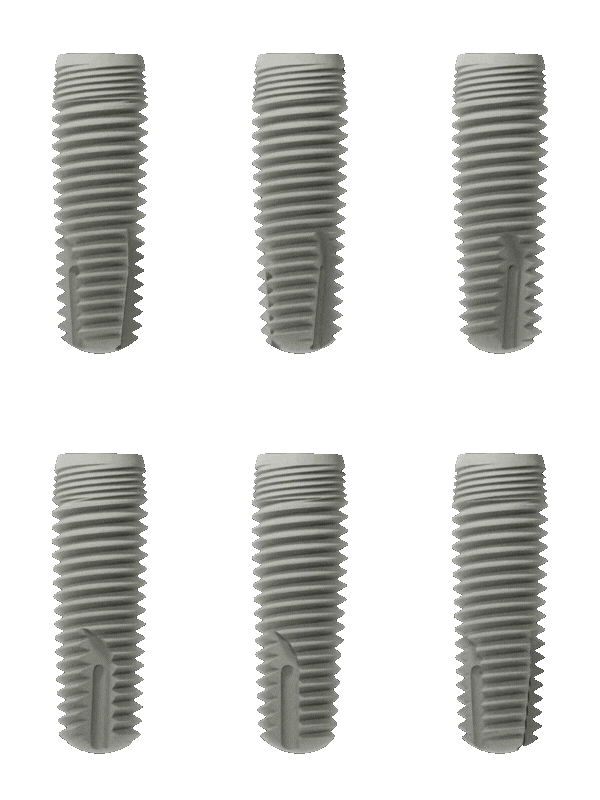
P1D
Designed for demanding bone.
The SGS P1D features a densely threaded macrogeometry developed particularly for hard-bone conditions, including mandibular D1 and D2 bone.
Its conical implant-abutment connection, platform-switching design and range of implant dimensions make it a dedicated option for clinicians evaluating implant placement in denser bone.
Diameters: Ø3.5, Ø3.75, Ø4.2 and Ø5.0 mm
Lengths: 6–16 mm, depending on diameter
Connection: SGS Conical Platform
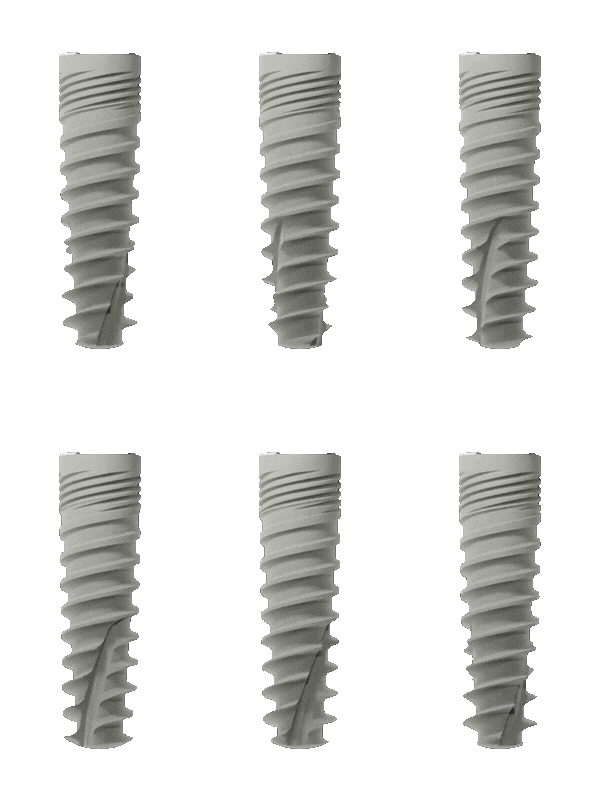
P7N
When space changes the equation.
The SGS P7N is a narrow-diameter implant developed for anatomical situations where a conventional implant diameter may not be appropriate.
Available in 3.0 and 3.2 mm diameters, P7N combines a dedicated narrow conical connection with platform switching and a slightly aggressive thread design..
Diameters: Ø3.0 and Ø3.2 mm
Lengths: 8–16 mm, depending on diameter
Connection: SGS Narrow Conical Platform
Choosing the right implant starts with the clinical situation.
Implant selection is not simply a question of choosing a diameter or achieving a particular insertion torque.
Bone quality, ridge dimensions, available mesiodistal space, the planned restoration and the surgical protocol all need to be considered together.
P1D and P7N address different aspects of this decision.

Dense bone
P1D is specifically positioned by SGS for hard-bone conditions, particularly D1 and D2 bone, where implant macrogeometry and osteotomy preparation require careful consideration.

Limited anatomical space
P7N provides a narrow-diameter option for selected sites where anatomical dimensions may restrict the use of a conventional implant diameter.
Neither implant should be selected on the basis of a single characteristic. Appropriate clinical assessment and restorative planning remain essential.
SBTC surface technology
Look beyond the implant.
Implant design is only one part of the system.
The clinical usefulness of an implant system depends on more than the fixture itself. Connection geometry, restorative components, instrumentation and access to technical information all contribute to the treatment workflow.
SGS supports its implant platforms with an extensive range of surgical and restorative solutions.

Conical connection
P1D uses the SGS Conical Platform, while P7N has its own dedicated Narrow Conical Platform.
Both incorporate platform switching, although their prosthetic connections and associated components are different.

Restorative flexibility
The SGS catalogue includes healing components, impression transfers, analogues, straight and angled abutments, temporary restorative solutions, multi-unit options and overdenture components across its implant platforms.

Digital workflows
Scanning components, digital analogues and titanium bases support CAD/CAM restorative workflows, with dedicated components for the standard conical and narrow conical platforms.

Surgical instrumentation
SGS provides implant-specific surgical instrumentation and technical resources, including guided surgery solutions within its wider portfolio. Compatibility and protocols should be checked for the selected implant system.
Explore SGS Implant Systems
Look at the engineering. Explore the system. Ask the questions.


